

3 Essential Views of Nonprofit Finances: Past, Present & Future
Most nonprofit leaders didn’t come up through finance. They came up through programs, fundraising, or advocacy. And somewhere along the way, they became responsible for an organization’s financial health without ever getting a clear picture of what that actually involves.
One of the most useful things I’ve found when working with nonprofit leaders is to simply map out the three parts of a finance function. Not as an accounting lesson, but as a way of understanding where attention is needed and why. Once you see the three parts clearly, a lot of the confusion about roles, reporting, and priorities starts to resolve itself.
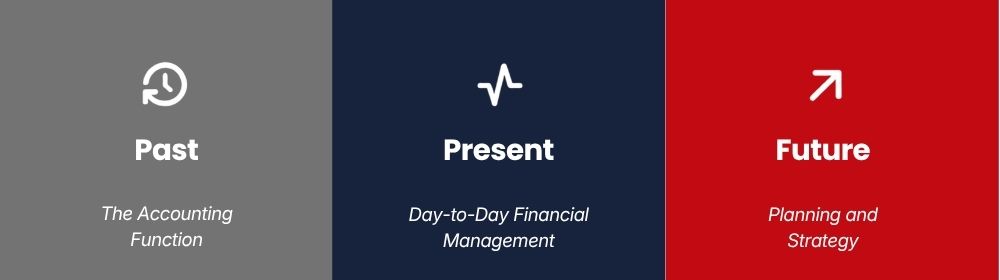
1. Looking backward: the accounting function
The first part of a nonprofit finance function is historical. It covers everything that has already happened: bookkeeping, bank reconciliations, financial statements, audit preparation, grant reporting, and compliance. This is the foundation. If it isn’t accurate and up to date, nothing else works well.
Last year a nonprofit came to us concerned they were about to lose their legal status because they hadn’t filed their tax returns (Form 990s). They hadn’t done their backward looking accounting. So we stepped in over the next six months, brought their books up to date, and filed the last three years of 990 forms.
This is also the part that tends to get the most attention, because it’s the most visible. Board members ask about the audit. Funders ask for financial statements. Staff ask about expense reimbursements. The backward looking function is the one with the most external accountability attached to it, which is why it often crowds out the other two.
2. Operating in the present: day-to-day financial management
The second part is current-day operations. This is where payroll gets processed, bills get paid, invoices go out, and cash gets managed. It’s less glamorous than the strategic work, but it’s the function that keeps the organization running week to week.
This is also where a lot of small problems become big ones if no one is paying attention. A payroll error that takes three cycles to untangle. A grant payment that doesn’t come in when expected creates an unexpected cash crunch. These compound quickly, and they create the kind of operational friction that pulls leadership away from mission.
The key here is not just having the work done, but having it done on a consistent rhythm, and having someone nearby who can fix things. When the current-day function runs smoothly, it fades into the background the way it should. When it breaks, it should be a quick fix, not a long term issue.
3. Looking forward: financial planning and strategy
The third part is where finance connects to leadership. It includes budgeting, multi-year planning, scenario modeling, cultivating the revenue relationships that will fund future work, and doing the deeper thinking about how the organization is going to sustain and grow its mission.
We recently started working with a 20+ year old organization that had never had a budget. It was fine during normal times, but when the board started to ask questions, no one knew any answers. The organization had not done any financial planning or strategy work, which led to lots of confusion and frustration.
This is the part that gets shortchanged most often, and it’s usually not because leaders don’t care about it. It’s because the first two parts of the finance function consume all the available time and energy. When the books are behind and the day-to-day is chaotic, there’s nothing left for forward-looking work.
Early in my time leading a nonprofit, we hit a two-month stretch where making payroll was going to be a real problem. Our donors weren’t in a position to cover the gap, so we used a line of credit to bridge it, which worked. But that line of credit only existed because we had grown large enough for a local bank to take us seriously. It’s a tool that simply wouldn’t have been available to us when we were smaller. Forward-looking financial management is what creates that kind of optionality. It’s the difference between having choices and not having them.
Why this framework matters
When leaders understand these three parts as distinct functions, they can start to ask better questions. Is our accounting function actually current and reliable? Do we have the right people and processes running our day-to-day operations? And are we spending enough time looking forward, or are we always catching up?
If you’re not sure which of these three parts is the weakest link in your finance function, that’s usually a good place to start the conversation.
Looking for more financial insight designed for nonprofit leaders?
Trustward’s newsletter is brief, practical, and relevant.