
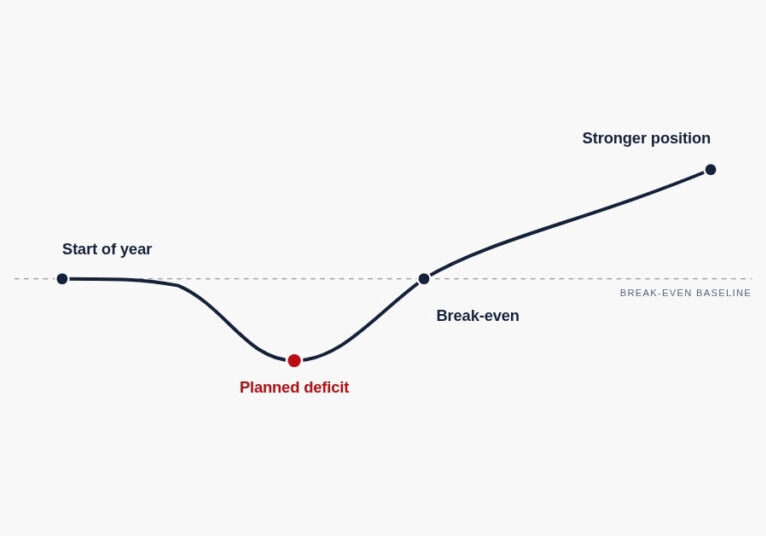
Is It Okay to Run a Planned Budget Deficit?
We often get this question from clients as budget season approaches, and most organizations fall into one of two camps.
On the one hand, I’m reminded of a client we’ve been working with that has been going to extraordinary lengths to end in the black every fiscal year. Their Executive Director feels tremendous pressure from the board to never run a deficit. This has come from a place of great intentions, a strong desire to safeguard the organization and ensure it remains solvent on their watch. But it’s started to become clear that their growing balance sheet comes with other costs. There have been crises they chose not to respond to, opportunities for growth and expansion that they’ve turned down, and much-needed investments in organizational infrastructure that they’ve deferred.
On the other hand, I’ve also been watching several nonprofits go through painful cycles of decline. Over the last couple of years, they’ve been spending down their reserves. With each budget cycle, leadership has pledged that “this is the year things turn a corner”. So they’ve put off hard decisions, hoped that their fundraising would see a dramatic lift. This has left them financially vulnerable, and in several cases they’ve had to make sudden and disruptive cuts, laying off staff and shuttering programs without warning.
Most organizations sit somewhere between these two. So the honest answer to whether a planned deficit is okay is almost never a simple yes or no. Over time, we’ve learned that to fully answer this question, there are four questions you need to answer before a deficit budget comes to a vote.
1. What is our historical trend?
The first step in evaluating a potential deficit is to take a step back and put it in context. A deficit that follows four years of surpluses is a completely different situation from the third annual deficit in a row, even when the number is identical.
This isn’t just about the numbers, it’s also about the culture and decision-making process of your organization. Do you have a history of discipline, focus, and fiscal stability? If yes, then a couple of modest deficits will likely be fine. But if you’ve been in a boom and bust cycle, with a history of getting too far over your skis financially and having to make painful cuts every couple of years, then maybe it’s time to take a hard look in the mirror and make a change.
2. How deep does this cut into our reserves?
Most nonprofit leaders we work with know to evaluate a deficit as a percentage of their annual budget. But it’s even more important to evaluate the deficit as a percentage of your reserves. This tells you how much this deficit will cost your organization in terms of its resilience and ability to weather an unexpected shock. It also gives you a sense for your margin for error. Spending 10% of your reserves to cover a deficit leaves you with plenty of buffer to face the unexpected. But spending down 50% of your reserves is a much weightier decision.
3. When will we be at our most vulnerable moment?
This is where we take our analysis of question 2 a bit further, and we don’t just look at how deep we cut, but when that cut will leave us the most vulnerable. If you don’t have a monthly cash flow forecast, this is when you absolutely need one. Some organizations have relatively stable cash-on-hand from month-to-month, but others experience more dramatic swings, particularly those that rely on major gifts and large grants. Find the moment when your cash-on-hand will be the lowest, and do a quick risk assessment. What kind of unexpected expenses or revenue losses might be possible at that moment? Will you have enough in reserves to cover that kind of hit?
4. What is our plan for getting back to a balanced budget?
Healthy, sustainable nonprofits have a clear, evidence-based plan for getting back to balanced budgets after a year or two of deficits, but undisciplined organizations just cross their fingers and hope something will change, or chase the next fad in fundraising.
I spent much of my career wearing the fundraising hat alongside the finance hat, and I’ve seen lots of fundraising fads come and go. Expanding a major gifts program with a full donor pipeline is a plan. Scaling a program with a strong logic model that has a record of securing grants is a plan. Counting on a viral video to break through, or hoping that adding the option to donate crypto on your website will make an immediate difference is not.
It’s not just about the numbers
These decisions are hard, and there are no cookie-cutter answers. Ultimately, the goal of these questions is to help you assess the impact of a deficit on your overall financial situation, but it’s just as important to ask yourself what’s really driving the budget dynamic here.
Organizations that are too spendthrift are often plagued by dysfunctional internal dynamics. Avoiding hard conversations about what’s working or what needs to change takes priority over sound financial decision-making. Penny-pinching organizations have the same problem in reverse – avoiding any kind of financial risk or discomfort takes priority over making smart investments that will advance the mission.
Ultimately, the goal should be a healthy organization doing the most good it can with what it has. Sometimes that means running a deficit on purpose, with clear eyes and a real plan. Sometimes it means telling a hopeful staff team that the evidence is not there yet to support dipping into reserves. The organizations that get this right can not only answer the four questions we’ve laid out, but they have a solid sense of their own values, pay attention to the dynamics driving their decision-making, and take the time to step back and assess the situation before diving in.
Looking for more financial insight designed for nonprofit leaders?
Trustward’s newsletter is brief, practical, and relevant.